
Introduction
You manage a company. Every day, you put forth a lot of effort. However, are you truly aware of whether your company is profitable or not?
A profit and loss statement tells you just that.
It is among the most crucial financial records for businesses. However, a lot of small company owners never give it a glance. Some people have no idea what it is.
That will be altered by this guide. You will discover the definition of a profit and loss statement, its components, how to interpret it, and how it might alter your company’s operations.
No technical terms. A degree in accounting is not required. Just straightforward, plain information.
What Is a Profit and Loss Statement?
A financial report is a profit and loss statement. It displays a company’s earnings and expenses for a given time frame.
Another name for it is:
- P&L report.
- Statement of income.
- Operational statement.
- Statement of earnings.
These names all have the same meaning.
One straightforward question is addressed by the profit and loss statement: Did your company turn a profit or a loss?
You made money if your earnings exceeded your outlays. You had a loss if your spending exceeded your revenue.
About 20% of small firms fail in their first year, according to the U.S. Small Business Administration. Many of them never kept accurate records of their earnings and outlays. You may prevent it by using a profit and loss statement. mistake.
What Does a Profit and Loss Statement Include?
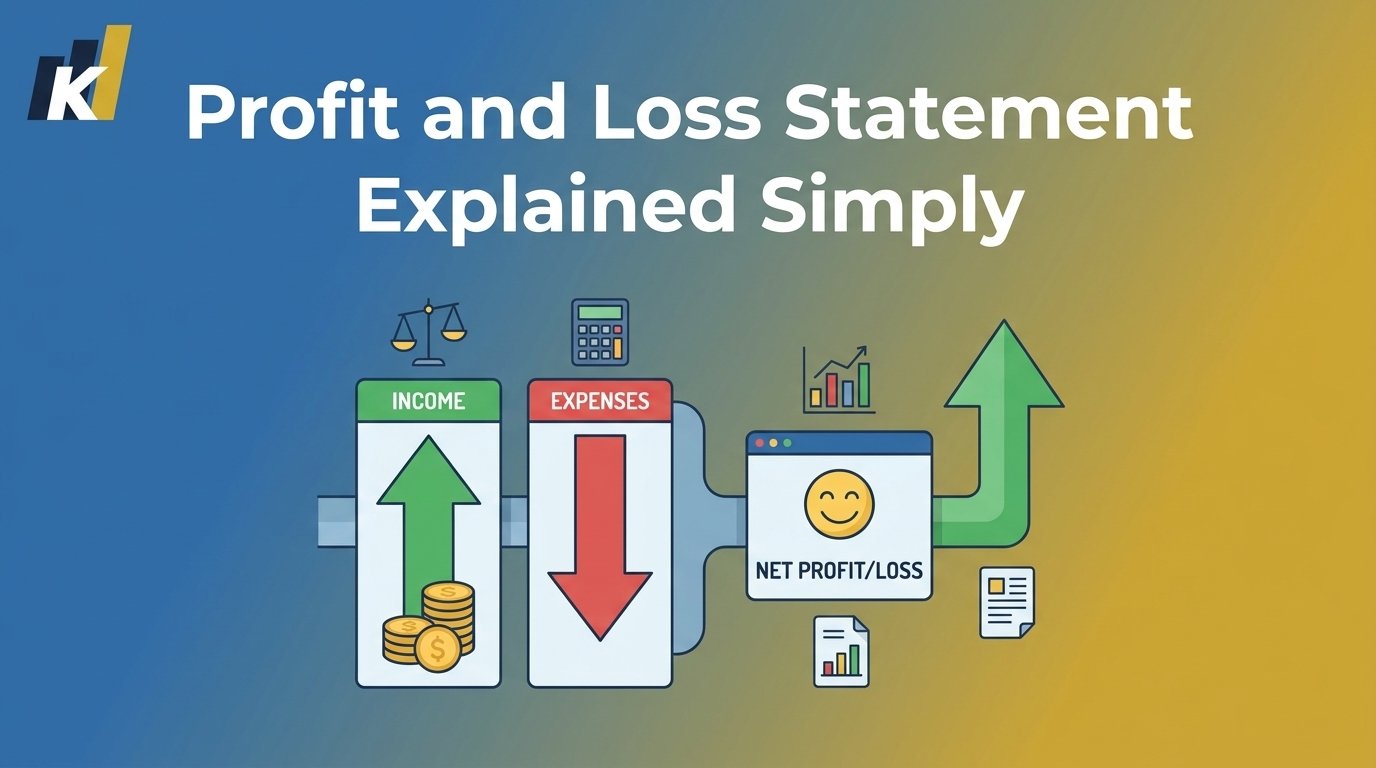
There are three primary components to a typical profit and loss statement:
1. Income
This represents the total revenue your company generated. It consists of:
- Product sales
- Fees for services
- Revenue from subscriptions
- Any additional revenue from the business
Your profit and loss statement’s top line is this. It is frequently referred to as “top-line revenue.”
2. Costs (Expenses)
This represents all of the money you spent operating the company. Typical costs consist of:
- Office expenses or rent
- Salaries for employees
- Advertising and marketing
- Tools and software
- Internet and utilities
- COGS, or cost of goods sold
All of these expenses are listed in detail in your profit and loss statement.
3. Net Gains or Losses
This is the last figure. entire expenditures are deducted from entire revenue.
Net Profit or Net Loss = Revenue minus Expenses
Your company turned a profit if the figure is positive. If it is negative, there was a loss for your company.
The “bottom line” of your profit and loss statement is this last figure.
How Often Should You Review Your P&L?
A profit and loss statement is often prepared on a monthly, quarterly, and annual basis.
Here’s a quick summary:
- Monthly P&L: Excellent for monitoring immediate results
- Quarterly P&L: Helpful for comparing company cycles or seasons
- Annual P&L: Needed for investor reporting and taxes
You may identify issues early by routinely reviewing your profit and loss statement. You will immediately notice if spending is increasing too quickly.
A Simple Real-World Example
Let us suppose you own a tiny internet shop.
In one month:
- You made $10,000 in sales (Revenue)
- You purchased goods for $3,000.
- $1,500 was spent on advertisements.
- You purchased software tools for $500.
- $5,000 was spent in total.
Net Profit = $10,000 – $5,000 = $5,000
$10,000 minus $5,000 equals $5,000 in net profit.
There was a $5,000 profit on your profit and loss statement for that particular month.
Imagine that you only made $10,000 the next month while spending $8,000 on costs. Your earnings fell to $2,000. This modification would be seen in your profit and loss statement. That’s a warning to check your expenditures.
Why Is a Profit and Loss Statement So Important?
A lot of business owners merely look at their bank account. That is insufficient.
The complete picture is provided by a profit and loss statement. This is why it’s important:
1. It displays how well your company is doing. You can determine if you are genuinely lucrative or simply busy.
2. It facilitates tax filing Your profit and loss statement. is necessary for your accountant or tax expert to create proper tax filings.
3. It draws lenders and investors. Before making an investment or providing money, banks and investors always need a profit and loss statement.
4. It facilitates improved decision. making You may reduce a certain expenditure before it negatively impacts your company if you see it developing quickly.
5. It displays patterns over time. Growth trends or warning indicators can be found by comparing profit and loss statements from two months or two years.
In the words of Warren Buffett, “Accounting is the language of business.” One of the most crucial pages in that language is the profit and loss statement.
Profit and Loss Statement vs. Balance Sheet
People often confuse these two.
Here is the simple difference:
| Document | What It Shows |
|---|---|
| Profit and Loss Statement | Income and expenses over a time period |
| Balance Sheet | Assets, liabilities, and equity at one point in time |
Both are important. But the profit and loss statement focuses on performance over time. The balance sheet is a snapshot of what you own and owe.
How to Create a Profit and Loss Statement
To begin, you don’t need an accountant. This is a straightforward, step-by-step procedure:
- Select a time frame – such as a month, quarter, or year.
- List all of your sources – of income and total them.
- Make a list of all your spending – no matter how small or large.
- Compute gross profit – by deducting the cost of products sold from revenue.
- Deduct running costs – such as marketing, rent, and wages.
- Determine your net profit or loss – This represents your bottom line.
A basic spreadsheet, accounting software such as QuickBooks, or even a free web template can be used.
Related post: https://www.investopedia.com/terms/p/plstatement.asp
Related post: https://www.sba.gov/business-guide/manage-your-business/manage-your-finances
Common Mistakes People Make With a P&L Statement
Even seasoned entrepreneurs make mistakes in this regard. Keep an eye out for these errors:
- Combining personal and business expenses: Always keep them apart
- Ignoring little expenses:Small expenditures can mount up.
- Not routinely examining it: A P&L is only useful if you do.
- Disregarding the price of products sold: This section of your profit and loss statement is crucial.
- Erroneously using cash basis against accrual: Be aware of the accounting approach you employ
Who Needs a Profit and Loss Statement?
In business, almost everyone needs one. This comprises:
- Independent contractors and sole proprietors
- Owners of small companies
- Owners of online stores
- Startups looking for capital
- Professionals who work for themselves
You may have a better understanding of your finances even if you work for yourself part-time by keeping track of your earnings and outlays using a basic profit and loss statement.
For freelancers managing multiple income streams, check out this related article on budgeting and income tracking: Related post: https://kashisfin.com/blog/
And if you are trying to grow your income through smart financial planning, this article on personal finance basics is a great start: Related post: https://kashisfin.com/blog/
How a Profit and Loss Statement Helps With Taxes
It’s hectic during tax season. However, it is considerably simpler with an accurate profit and loss statement.
Here’s how:
- It displays your company’s annual revenue.
- It provides a concise list of all deductible costs.
- It lessens the possibility that your tax return may contain mistakes.
- It helps your accountant save time.
- By displaying actual business expenses, it could help you legally pay less in taxes.
In the event of an audit, the IRS or other tax body will frequently start by looking at a well-prepared profit and loss statement.
About Profit and Loss Statement
Q1. To put it simply, what is a profit and loss statement?
A report that details how much money a company made and spent over a specific time period is called a profit and loss statement. It indicates whether the company made money or lost money.
Q2. How frequently should a profit and loss statement be prepared?
The majority of companies do this on a monthly, quarterly, and annual basis. The best way to manage your money is on a monthly basis.
Q3. Are an income statement and a profit and loss statement equivalent?
Indeed. An income statement and a profit and loss statement are identical. They simply go by other names.
Q4. Is a profit and loss statement necessary for independent contractors?
Indeed. A basic profit and loss statement helps freelancers keep track of their earnings and outlays. It aids with company planning and taxation.
Q5. On a P&L statement, what distinguishes net profit from gross profit?
Revenue less the cost of products sold equals gross profit. What remains after deducting all expenditures, like as taxes and operational expenses, is known as net profit.
Final Thoughts
Not only are large corporations or accountants required to have a profit and loss statement? Anyone who makes money from a business or freelance job is eligible.
It provides you with the truth about your company. Do you make money? Are you overspending? Are you developing?
You are operating in the dark without a profit and loss statement. You have a clear map when you have one.
Begin simply. Keep tabs on your earnings. Keep tabs on your spending. Determine the difference. Your initial profit and loss statement is that.
You will make better judgments, spend more sensibly, and confidently expand your firm after you develop the habit of routinely examining your profit and loss statement.