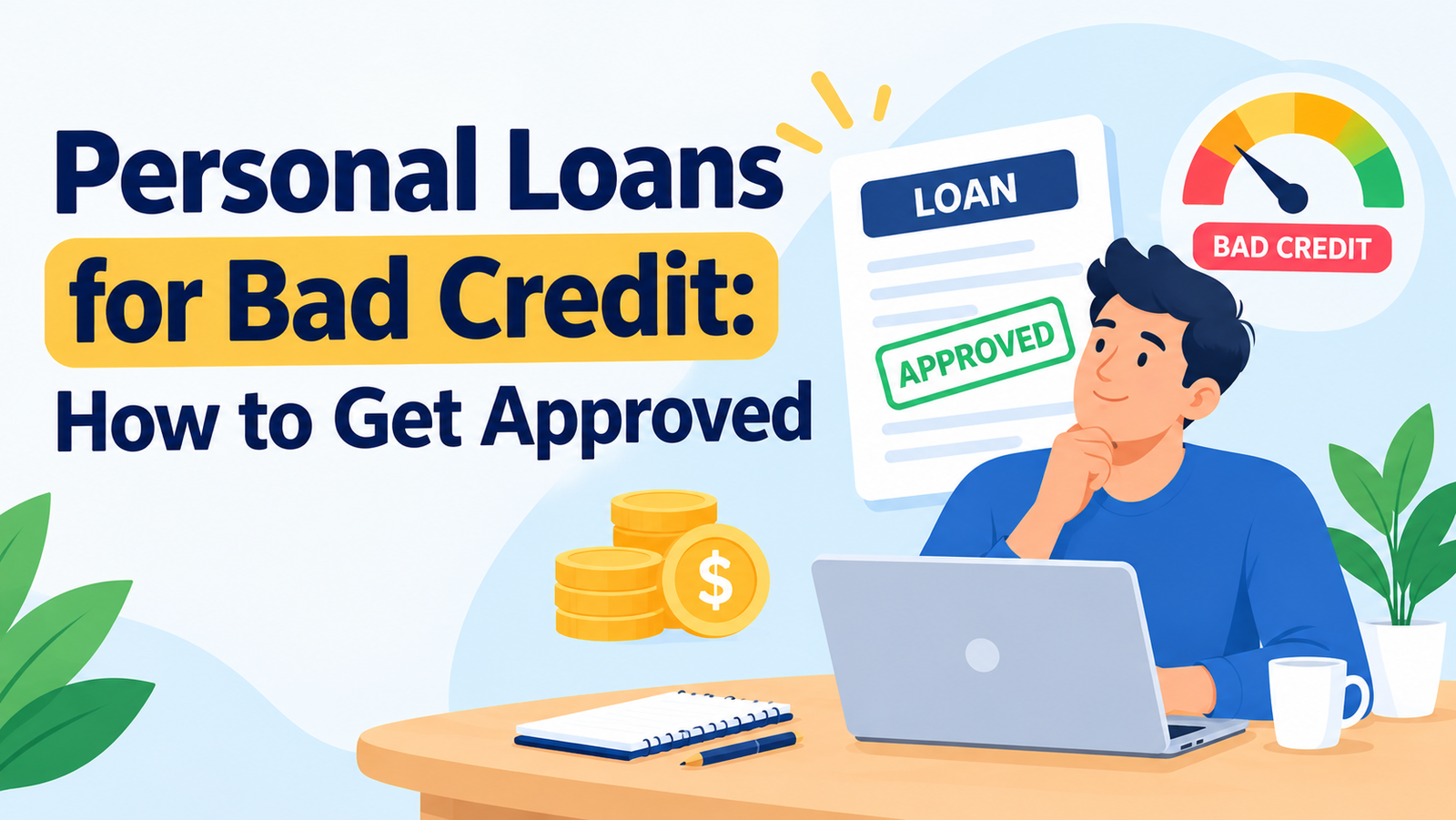
A low credit score can make borrowing feel impossible. It is not. Some lenders approve borrowers with fair, poor, or even no credit history. The catch is the price. You will usually pay more.
This guide shows you how personal loans for bad credit work, what they cost, and how to qualify. It also covers loans with no credit check and the safer options to consider first. Rates and terms below come from 2026 lender and review site listings. They change often, so check each lender before you apply.
Quick Answer: Can You Get a Personal Loan With Bad Credit?
Yes, you can. Many online lenders, credit unions, and finance companies approve people with scores below 670. Expect a higher interest rate, often near or above 30% APR for scores under 580. Lower loan amounts and extra fees are also common.
What Counts as Bad Credit?
Bad credit means a low credit score. Lenders use this number to guess how likely you are to repay.
The FICO scoring model uses these ranges:
| FICO Score | Rating |
|---|---|
| 300 to 579 | Poor |
| 580 to 669 | Fair |
| 670 to 739 | Good |
| 740 to 799 | Very good |
| 800 to 850 | Exceptional |
Many lenders treat a score below 580 as bad credit. Some also use that label for scores up to about 630. Every lender sets its own line.
Three credit bureaus keep your credit reports: Equifax, Experian, and TransUnion. Lenders pull data from one or more of them.
How Personal Loans for Bad Credit Work
A personal loan gives you a lump sum. You repay it in fixed monthly payments over a set term. Most terms run from two to seven years. Most personal loans are unsecured, so you do not put up a car or home as collateral.
With bad credit, a lender sees more risk. It protects itself in these ways:
- A higher APR
- A smaller loan amount
- An origination fee taken from your loan
- A shorter term, or sometimes a longer one with more total interest
APR stands for annual percentage rate. It includes interest and some fees, so it shows the true yearly cost better than the interest rate alone.
What Do Bad Credit Loans Cost?
Lender listings in 2026 commonly show APR ranges from about 6% to 35.99% across all credit levels. Borrowers with poor credit usually land near the top of that range. Credible reported an average APR of 29.74% for its bad credit borrowers, with an average credit score of 562.
Here is a simple example. You borrow $5,000 for 36 months.
| APR | Monthly Payment | Total Interest |
|---|---|---|
| 12% | About $166 | About $979 |
| 30% | About $212 | About $2,641 |
| 36% | About $229 | About $3,245 |
At 30% instead of 12%, you pay about $1,660 more in interest. That is the real cost of bad credit. It is also why comparing offers matters.
Fees to Watch For
- Origination fee: A one-time charge, often taken from the loan amount. Some lenders charge up to about 10% or more. NerdWallet lists Upstart’s fee at up to 12%.
- Late fees: Charged when you miss a due date.
- Prepayment penalty: A charge for paying the loan off early. Many lenders do not charge it. Check before you sign.
If you borrow $5,000 with a 10% origination fee, you receive $4,500 but repay $5,000 plus interest.
Who Offers Personal Loans for Bad Credit?
You have several types of lenders to compare.
Online Lenders
Online lenders let you check your rate in minutes. Some look at more than your credit score. For example, Upstart says it also considers factors like education and employment. Other names you may see include Avant, Upgrade, and OneMain Financial. In 2026 listings, minimum scores ranged from none to about 600, and APRs generally ended at 35.99%.
Credit Unions
Credit unions are nonprofit lenders owned by their members. Federal credit unions can offer Payday Alternative Loans, called PALs. The National Credit Union Administration caps the PAL interest rate at 28%. You must be a member, and you may need to wait before you qualify.
Banks
Large banks often want good credit. If you already bank with one, it may still be worth a look. Your account history can help.
Finance Companies
Some finance companies offer secured loans backed by a car. These can help when you cannot get an unsecured loan. You risk losing the car if you stop paying.
How to Get a Personal Loan With Horrible Credit
If your score is very low, you can still take steps to improve your odds. Here is the process.
- Check your credit reports. Visit AnnualCreditReport.com, the official free source. Look for mistakes like wrong late payments or accounts that are not yours.
- Dispute errors. Wrong items can pull your score down. Fixing them can raise it.
- Decide how much you need. Borrow only what you need. A smaller loan is easier to get approved and cheaper to repay.
- Count your income and debts. Lenders look at your debt-to-income ratio, which compares your monthly debt payments to your monthly income. A lower ratio helps.
- Prequalify with several lenders. Prequalification shows estimated rates, usually with a soft credit check. A soft check does not hurt your score.
- Consider a co-signer or collateral. A co-signer with better credit can lower your rate. A secured loan can too. Both add risk for someone.
- Compare the full cost. Look at APR, fees, and the total you will repay. Do not compare only the monthly payment.
- Apply to the best offer. The formal application triggers a hard credit check. A hard inquiry can lower your score by a small amount for a short time.
Common mistake: Applying to many lenders for full approval in one week. Prequalify first so you only take one hard inquiry.
What Lenders Look at Besides Your Score
Your score is not the only factor. Lenders may review:
- Your income and job history
- Your debt-to-income ratio
- Your bank account activity
- Your payment history
- Any recent bankruptcies, collections, or defaults
Steady income can help a lot. A recent missed payment can hurt more than an older one.
Loans With No Credit Check: What You Should Know
Loans with no credit check promise approval without a look at your credit report. They sound simple. They are often very expensive.
Common types include:
- Payday loans: Short-term loans due on your next payday. The Consumer Financial Protection Bureau explains that a typical two-week payday loan fee equals an APR of almost 400%.
- Car title loans: You use your car title as collateral. Miss payments, and you can lose the car.
- Pawn loans: You leave an item with the lender. You may lose it if you do not repay.
- Some installment lenders: They may skip a hard credit check but charge very high rates.
Many of these lenders still check other databases or your bank account. “No credit check” does not mean “no risk.”
Warning Signs of a Loan Scam
- The lender asks for a fee before you get the loan
- The lender guarantees approval no matter what
- The lender contacts you first with an unrequested offer
- The lender asks for payment by gift card or wire transfer
- You cannot find a real address or license
The Federal Trade Commission warns borrowers about advance fee loan scams. A real lender takes fees from the loan or adds them to your balance. It does not ask you to send money first.
Better Options to Compare Before You Borrow
A personal loan is not the only path. Look at the cost of each choice.
| Option | Typical Strength | Main Limit |
|---|---|---|
| Credit union PAL | Rate capped at 28% | Membership rules and small amounts |
| Secured loan | Lower rate possible | You can lose your collateral |
| Co-signed loan | Better rate and approval odds | Your co-signer shares the risk |
| Credit builder loan | Helps build credit | Does not give you cash right away |
| Payment plan with the creditor | Often no new debt | Not always available |
| Nonprofit credit counseling | Free or low-cost guidance | Takes time |
For medical bills, utility bills, or rent, ask the company about a payment plan first. Many will work with you.
Pros and Cons of Personal Loans for Bad Credit
Pros
- You get money in one lump sum
- Fixed payments make budgeting easier
- Rates are often lower than payday loans
- On-time payments can help your credit
- Debt consolidation may lower your costs if the new rate is lower
Cons
- APRs can reach 35.99% or more
- Origination fees reduce what you receive
- Late payments can hurt your score further
- A longer term means more total interest
When a Bad Credit Loan Makes Sense
A bad credit personal loan may fit when:
- You have a real, urgent need
- You can afford the monthly payment
- The APR is lower than your other options
- You are paying off higher-interest debt, like a card at a much higher rate
It may not fit when:
- The payment would strain your budget
- The APR is higher than 36%
- You want to cover regular spending
- You could use a cheaper option, like a PAL or a payment plan
Many consumer groups use 36% APR as a warning line. The Military Lending Act already caps APRs at 36% for active-duty service members and their dependents.
Common Mistakes to Avoid
- Choosing by monthly payment only. A low payment over a long term can cost far more overall.
- Ignoring the fees. An origination fee changes how much cash you receive.
- Skipping the fine print. Check late fees and prepayment rules.
- Borrowing the maximum. Take only what you need.
- Trusting guaranteed approval. No honest lender can promise it.
- Missing the first payment. Set up autopay if you can.
How to Improve Your Odds After a Denial
If a lender says no, it must tell you why. Under federal law, you can ask for the reasons. Common ones include low credit score, high debt, and short job history.
Next, work on the reason you were denied. You can pay down card balances, fix report errors, or add a co-signer. Wait a few months before you apply again.
Expert Tips
- A lower credit card balance can raise your score fairly fast. Credit utilization, which is how much of your card limit you use, matters a lot.
- If you get approved, make every payment on time. Ask whether the lender reports to all three credit bureaus.
- Compare at least three offers. Rates for the same borrower can differ a lot.
- Read the full loan agreement before you sign.
This article is for education. It is not financial or legal advice. Talk with a licensed professional for advice on your situation.
Frequently Asked Questions
What credit score do I need for a personal loan?
It depends on the lender. Some accept scores near 580. Others have no minimum and look at income and other factors. Lower scores bring higher rates.
What is the easiest personal loan to get approved for?
Secured loans and co-signed loans are often easier to get. Credit union PALs can also be easier for members. Easier approval often comes with higher cost or more risk.
Can I get a personal loan with no credit check?
Some lenders offer them, but they often charge very high rates. Payday and title loans are the most common types. Compare them with a credit union PAL or a payment plan first.
Does checking my loan rate hurt my credit?
Prequalification usually uses a soft inquiry, which does not affect your score. A full application uses a hard inquiry, which can lower your score slightly for a short time.
How fast can I get the money?
Some online lenders fund as soon as the next business day after approval. Timing depends on the lender and your bank.
Can a bad credit loan help me build credit?
Yes, if the lender reports to the credit bureaus and you pay on time. Late or missed payments can hurt your score.
Are personal loans for bad credit safe?
Loans from licensed, transparent lenders can be safe. Watch for upfront fees, guaranteed approval claims, and extreme rates.
What is a good APR for bad credit?
There is no single number. Rates near 30% are common for poor credit. A lower offer is better, and a rate above 36% is a warning sign.
Final Thoughts
Personal loans for bad credit exist, and many lenders approve borrowers with low scores. The price is usually a higher APR and extra fees. Your best result comes from knowing your credit, comparing several offers, and staying away from no credit check loans with very high rates.
Look at the full cost, not just the monthly payment. A loan you can repay on time is safer than one that is easy to get.