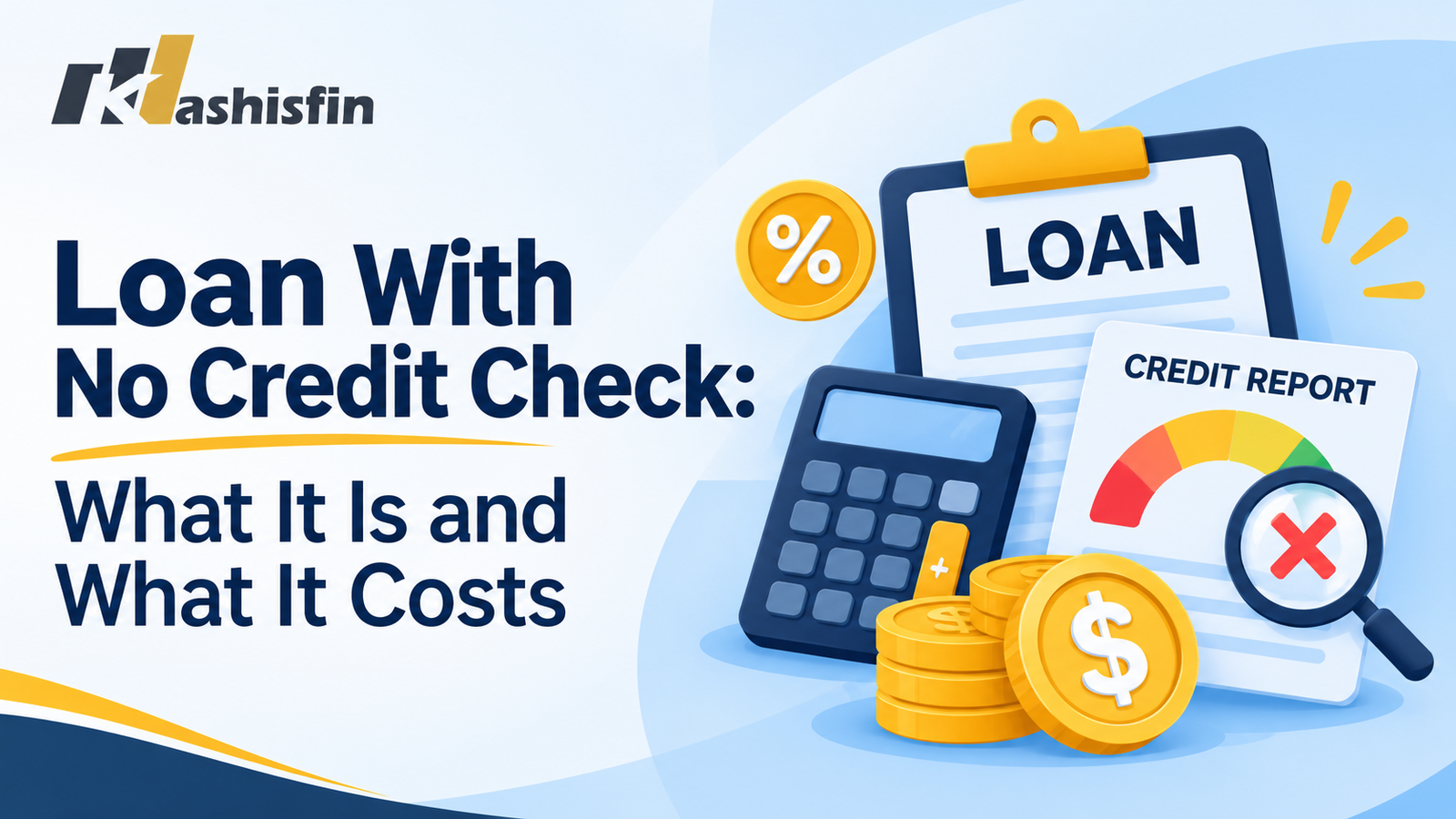
You need money soon. Your credit score is low, or you have no credit history at all. So you search for a loan with no credit check and hope for a quick yes.
This guide explains how these loans work in the United States. You will see the main types, the real costs, the risks, and the lower-cost options. You will also learn how to spot scams.
Quick Answer: Can You Get a Loan With No Credit Check?
Yes. Some lenders do not check your credit report with the three major bureaus. They look at your income and bank account instead. These loans are often very expensive. Payday loans can reach about 391% APR, and a person can end up owing far more than they borrowed.
What Is a Loan With No Credit Check?
A loan with no credit check is a loan where the lender does not review your credit report from Equifax, Experian, or TransUnion before approval.
That does not mean the lender checks nothing. Most still do these things:
- Confirm your identity
- Confirm you have steady income
- Confirm you have an active bank account
- Check specialty databases that track short-term loan use
So the phrase can be misleading. The lender skips the standard credit check, but you still need to qualify in other ways.
Why Lenders Offer Them
Lenders who skip credit checks take on more risk. They cover that risk with high fees. They also try to lower risk by getting direct access to your money. For example, they may ask you to allow automatic withdrawals from your bank account, or they may hold your car title.
Who Usually Uses Them
People often search for these loans when they:
- Have a low credit score
- Are new to credit, such as young adults or recent immigrants
- Have a past bankruptcy, collection, or missed payments
- Face an urgent bill and have no savings
Types of No Credit Check Loans
Each type works differently. The cost and risk change a lot from one to the next.
Payday Loans
A payday loan is a small, short-term loan. You usually repay it on your next payday, often within two weeks.
The lender charges a flat fee. A common fee is $15 for every $100 borrowed. The typical storefront loan is about $350 for 14 days, and a $15 fee per $100 works out to roughly 391% APR.
Example: You borrow $300. The fee is $45. You owe $345 in two weeks.
If you cannot pay the full amount, the lender may let you extend the loan for another fee. This is called a rollover. Pay $45 to extend it three times and you have paid $180 in fees. You still owe the original $300.
Car Title Loans
A title loan uses your car as security. You give the lender your car title, and you keep driving the car while you repay.
Many title loans last about 30 days. The Consumer Financial Protection Bureau (CFPB) has reported that a common fee is 25% of the amount borrowed per month. That is about 300% APR.
Example: You borrow $500 and the fee is 25%. You owe $625 after one month.
The big risk is losing your car. If you miss payments, the lender can take it.
Pawn Loans
At a pawn shop, you leave an item, such as jewelry or electronics. The shop gives you a loan based on the item’s value.
If you repay on time, you get the item back. If you do not, the shop keeps it. You do not owe more. Pawn loans do not usually hurt your credit, because you lose the item instead of facing collections. Fees and interest still apply and vary by state.
Installment Loans With Soft Checks or Alternative Data
Some online lenders use a soft credit pull or alternative data. A soft pull does not lower your credit score. These lenders may look at your bank account activity, income, job history, or rent payments.
These are not always “no credit check” in the strict sense. They can still cost a lot, but they often have longer repayment terms and lower rates than payday loans. Always read the full terms.
Cash Advance Apps
Some apps give you a small advance on your paycheck. They often do not run a hard credit check. Many charge monthly fees, express fees, or ask for tips. Add up all the costs before you use one.
Comparison: No Credit Check Loan Types
| Loan Type | Typical Amount | Typical Term | Typical Cost | Main Risk |
|---|---|---|---|---|
| Payday loan | Often $500 or less | About 2 to 4 weeks | About $15 per $100 (around 391% APR) | Rollovers and repeat borrowing |
| Car title loan | Based on car value | Often 30 days | Often 25% per month | Losing your car |
| Pawn loan | Based on item value | Often 1 to 4 months, varies by state | Varies by state | Losing your item |
| Soft-check installment loan | Varies | Months to years | Varies, often high | High APR over a long time |
| Cash advance app | Small amounts | Until next paycheck | Fees or tips | Fees can add up |
How Much Does a Loan With No Credit Check Cost?
APR means annual percentage rate. It shows the yearly cost of a loan. It lets you compare different loans fairly.
Short loans with flat fees look cheap but have a huge APR. Here is the math for a payday loan:
($15 fee ÷ $100 loan) × (365 days ÷ 14 days) × 100 = about 391% APR
For comparison, credit cards often have APRs of roughly 20% to 30%. Even a card with a high rate costs far less than a payday loan.
Hidden Costs to Watch For
- Rollover fees: You pay again to extend the loan.
- Late fees: Added when you miss a due date.
- Bank overdraft fees: Your bank may charge you if the lender pulls money you do not have.
- Returned payment fees: Both the lender and your bank can charge you.
- Origination fees: Taken out of the loan before you get the money.
Risks of No Credit Check Loans
Knowing the risks helps you decide with clear eyes.
The Debt Cycle
Many borrowers cannot repay the full amount on the due date. They borrow again to cover the old loan. The CFPB has found that most payday loan fees come from people who borrow many times in a year.
Automatic Bank Withdrawals
Many lenders ask for access to your bank account. If your balance is low when they pull payment, you may face overdraft fees. You may also have less money for rent and food.
Losing Property
Title and pawn loans put your property at risk. Think about whether you could handle losing that item.
Credit Impact
Most of these loans do not report on-time payments to the credit bureaus. So they usually do not help build your credit. If you default and the debt goes to collections, your credit can be hurt.
State Laws Differ
Rules change by state. Some states ban or cap payday loans. Others allow high fees. A lender must follow the law where you live, so check your state’s rules and the lender’s license before you apply.
How to Spot a Loan Scam
Scammers target people who need money fast. Watch for these signs:
- Fees before the loan. The Federal Trade Commission (FTC) warns that real lenders do not ask for upfront fees for a loan you have not received. Be careful if someone asks for gift cards, wire transfers, or crypto.
- A “guaranteed” approval. No real lender can promise approval before reviewing your details.
- Pressure to act now. Scammers want you to rush.
- No clear company information. Look for a physical address, a license, and reviews from independent sources.
- Requests for your full bank login. Be careful with anyone who asks for your online banking password.
If a loan feels wrong, stop. You can report scams to the FTC at ReportFraud.ftc.gov.
Lower-Cost Options to Consider First
Before you take a no credit check loan, look at these options. Many cost much less.
Payday Alternative Loans (PALs) From Credit Unions
Federal credit unions offer Payday Alternative Loans. The National Credit Union Administration (NCUA) sets the rules.
- PAL I: $200 to $1,000, with terms of 1 to 6 months. You must be a member for at least one month.
- PAL II: Up to $2,000, with terms up to 12 months. No waiting period for membership.
- The maximum APR is 28%.
- The application fee can be no more than $20.
Example: A $500 loan over 6 months at 28% APR costs about $42 in interest. Compare that with $75 for just one two-week payday loan on the same amount.
Credit unions often look at more than your score. Some will work with people who have low scores.
Ask for Help From Your Employer
Some employers offer paycheck advances or earned wage access. Ask your HR department. Terms vary, so check the fees.
Negotiate With the Person You Owe
If the money is for a bill, call the company. Many utilities, landlords, and medical offices offer payment plans or short delays. This often costs less than a loan.
Local Assistance Programs
You can call 211 in the US to find local help with rent, utilities, food, and other needs. Nonprofits and community groups may give emergency aid.
Secured Loans or Credit-Builder Loans
A secured loan uses your savings or another asset as backup. A credit-builder loan holds the money in an account while you pay, then releases it. These can help you build credit while you borrow.
Co-Signer Loans
A co-signer with good credit may help you qualify for a regular loan at a lower rate. The co-signer is responsible if you do not pay, so this works best when both people understand the risk.
Step-by-Step: How to Check a Lender Before You Borrow
- Check the lender’s license. Search your state’s financial regulator website. Confirm the lender can operate in your state.
- Read the APR and total cost. Federal law requires lenders to show the APR for most loans. Add up all fees.
- Compare at least two other options. Check a credit union and one more lender.
- Read the repayment terms. Look at the due date, the payment method, and what happens if you pay late.
- Check for rollover rules. Know the cost to extend the loan before you sign.
- Do not pay upfront fees. If the lender asks for money before giving you a loan, stop.
- Keep copies. Save the contract, receipts, and messages.
Special Rule for Military Members
The Military Lending Act caps the cost of many consumer loans at 36% for active-duty service members and their covered dependents. This rate includes many fees, not just interest. Military families can also ask about aid from Military OneSource and relief societies tied to each branch.
Common Mistakes to Avoid
- Borrowing more than you need. Extra money means extra fees.
- Only looking at the fee, not the APR. A “small” fee on a short loan can be huge when annualized.
- Ignoring the due date. Missed payments lead to more fees and possible collections.
- Using one loan to pay another. This is how the debt cycle starts.
- Applying to many lenders at once. Each lender may pull your data, and some scam sites sell your information.
- Not reading the contract. Terms like automatic withdrawals and rollover fees are in the fine print.
Expert Tips
- Match the loan to the problem. A one-time bill that you can repay by your next paycheck is a different case from a long-term money gap. Short loans do not fix long-term gaps.
- Do the math before you sign. Write down the full amount you must repay and the exact date. Compare it with your income and bills.
- Check where your data goes. Some sites collect your information and sell it to many lenders. Use a site with a clear privacy policy.
- Ask about credit reporting. If a lender reports on-time payments to the bureaus, the loan may help your score. Most no credit check lenders do not.
Frequently Asked Questions
Is there a loan with no credit check and guaranteed approval?
No. Any lender that promises guaranteed approval before reviewing your details is not following normal lending practice. Real lenders must check that you can repay. A “guaranteed” claim is a warning sign of a scam.
Do no credit check loans hurt your credit score?
Most do not run a hard inquiry, so applying usually does not lower your score. On-time payments also usually do not raise it. If you stop paying and the lender sends the debt to collections, your credit can drop.
What do you need to get a no credit check loan?
Most lenders ask for a government ID, proof of income, an active checking account, and your contact details. You must be at least 18 years old. Some states set other rules.
How fast can you get the money?
Some online lenders send money the same day or the next business day. Storefront lenders may give you cash on the spot. Speed does not change the cost, so still check the APR.
Can I get a no credit check loan with bad credit or no credit history?
Yes, you may qualify, because the lender focuses on income and bank activity. But the cost is usually high. A credit union PAL or a secured loan may cost less and still accept lower scores.
What is the cheapest alternative to a payday loan?
A credit union Payday Alternative Loan is often among the lowest-cost choices. It has a maximum APR of 28% under NCUA rules. Payment plans with the company you owe can also cost very little or nothing.
Are no credit check loans legal?
In most states, yes, but each state has its own rules. Some states cap fees or ban payday loans. A lender must have the right license for your state.
What happens if I cannot repay on time?
You may face late fees, rollover fees, and overdraft fees. The lender may keep trying to pull payments from your bank account. Title lenders can take your car. Pawn shops keep your item. If the debt goes to collections, your credit can be hurt. Call the lender before the due date to ask about your options.
Final Thoughts
A loan with no credit check is real, and it can be quick to get. But the cost is often very high. Payday loans can reach about 391% APR, and title loans often charge 25% a month. Small amounts can turn into large debts.
Before you borrow, read the APR, add up every fee, and confirm the lender’s license. Compare the loan with a credit union Payday Alternative Loan and with payment plans from the people you owe. The right choice depends on how much you need, how soon you can repay, and what you could lose if something goes wrong.